



Feb 19, 2022
1032
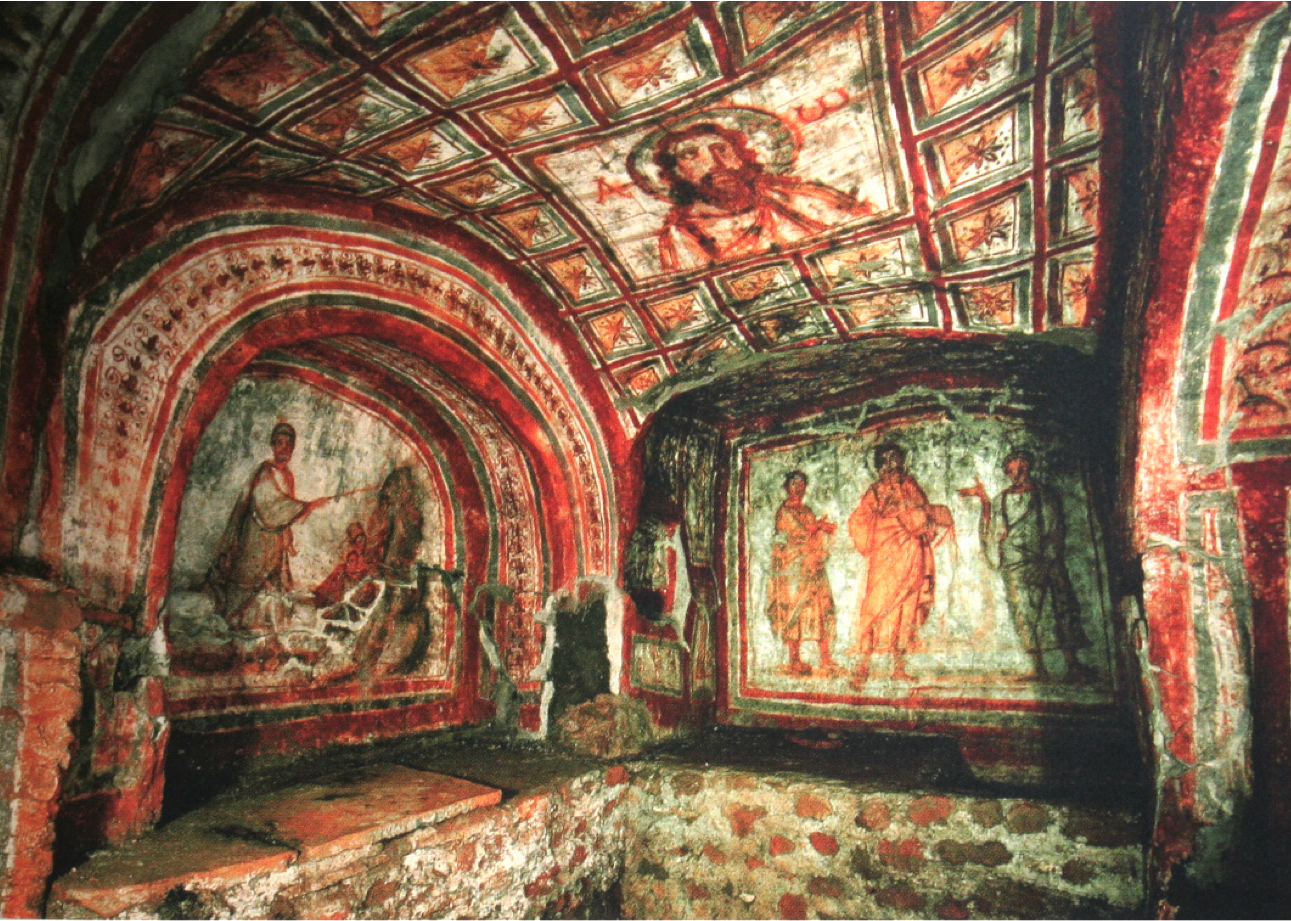
Visiting the catacombs means undertaking a journey through subterranean Rome, where one can discover the gallery of tunnels in which first the pagans, then Christians buried their dead. Fascinating places that narrate ancient Roman customs and traditions, more than 60 catacombs and thousands of tombs exist in and around Rome.
Additionally, there were six Jewish catacombs – four of which have disappeared, while the other two remain closed. The Roman catacombs were constructed along the ancient Roman roads (viae consulares) – Via Appia, Ostiense, Labicana, Tiburtina, and Nomentana. Only five catacombs are open to the public today: San Callisto, San Sebastiano and Santa Domitilla in the Appia Antica zone, and Priscilla and S.Agnese in the area of Nomentano-Salario.
Roman law prohibited burying of the dead inside the old city walls, for sanitary reasons. The ancient Roman ways were lined with elaborate gravesites of society patricians; they were often cremated and their ashes were preserved in urns. The first Christians, rather, maintaining that they should be ready for the Resurrection, were not cremated but buried in the underground caves, dug in tufo or lava stone. Once their bodies were wrapped in two layers of cloth soaked with lye (to stave off risk of contamination), they were then deposited in niches inside the cave walls.
Scholarly opinion varies in regards to the catacombs. While some hold that the first Christians used the catacombs as places of refuge from persecution, others believe that they were meeting-points for honoring the deceased – particularly martyrs and Popes – usually with a banquet or feast. Today the tutelage of the Christian catacombs is entrusted to the Pontificia Commissione di Archeologia Sacra (The Pontifical Commission for Sacred Archaeology), which manages excavations and restorations.
The word “catacomb” is by now used to define just about any underground necropolis. However, the ancient term was “coemeterium” deriving from the Greek for "dormitorium," which emphasized the fact that Christians viewed burial as a passing moment before the Resurrection. Moreover, according to some scholars, the term catacomb can be extended to all the Christian cemeteries, yet in antiquity it actually defined the S. Sebastiano complex on the Via Appia. It was also the reference for the stone quarries surrounding the S. Sebastiano catacomb.
You may be interested
-
Exciting Palatine. Interview with Clementina...
You can tell she fills with excitement when she has the chance to show an important archae...
-
Italian Open's History and Records: A tale o...
For Italians, and Romans in particular, the Open is not just a tennis tournament where cha...
-
'Basilica of Mysteries' reborn in Rome
The so-called 'Basilica of the Mysteries' has been reborn in Rome. The basilica, one of th...
-
'Carbonara Day' celebrates famous pasta dish
On Friday, April 6, the world will celebrate "Carbonara Day", an occasion launched by the...
-
'Gladiators' bring Roman flavor to R.I. polo
As thousands of sharply dressed spectators converged on the turf of Newport International...
-
'Hot priests' grace Rome's calendar
It is officially called the Calendario Romano, or Roman Calendar. But on the streets of Ro...
-
'No one should be left behind': Italian teen...
A 15-year-old boy, known as Simone, has become an overnight internet sensation after stand...